Theory
In 1843, the English scientist Charles Wheatstone invented the bridge circuit bearing his name. It is widely
used for rapid and precise resistance measurements.WheatstoneBridge consists of network of fourresistance arms
forming a closed
circuit, with a dc sourceThe resistances R1, R2, and R4 are known, and the resistance R3 is to be determined.
The resistance R4 is variable. The meter between nodes b and c can be a sensitive ammeter or voltmeter.
In the use of the bridge, the resistance R4 is adjusted until the meter movement shows no deflection. Then Vg,
the galvanometer voltage, is zero, which means that nodes b and c must be at the same potential. Consequently,
the voltage drop
from a to b equals that from a to c. Also, the voltage drop from b to d equals that from c to d.
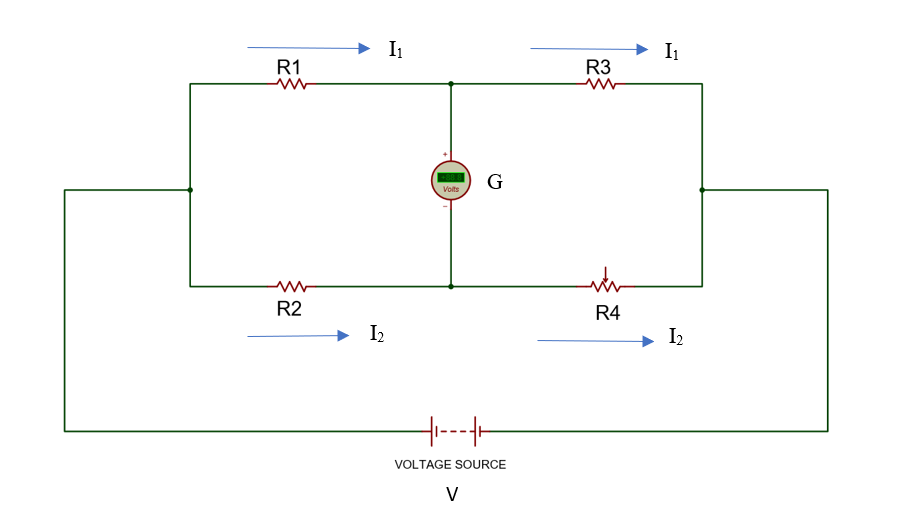
Further, since the meter current is zero, the current I1 flows through resistor R1 and also through resistor R3.
Similarly, the current I2 flows through resistors R2, and R4.
Since
Vab = Vac, then: I1R1 = I2R2.
Also,
Vbd = Vcd, then: I1R3 = I2R4.
The division of equations yields:
I1R1 / I1R3 = I2R2 / I2R4
,
which reduces to R3 = (R1*R4) / R2
(Wheatstone bridge balance equation)
This is the bridge balance equation. With the bridge balanced, this equation can be used to determine the
resistance R3 to a precision that is nominally the same as the precision of the resistances R1, R2, and R4.